
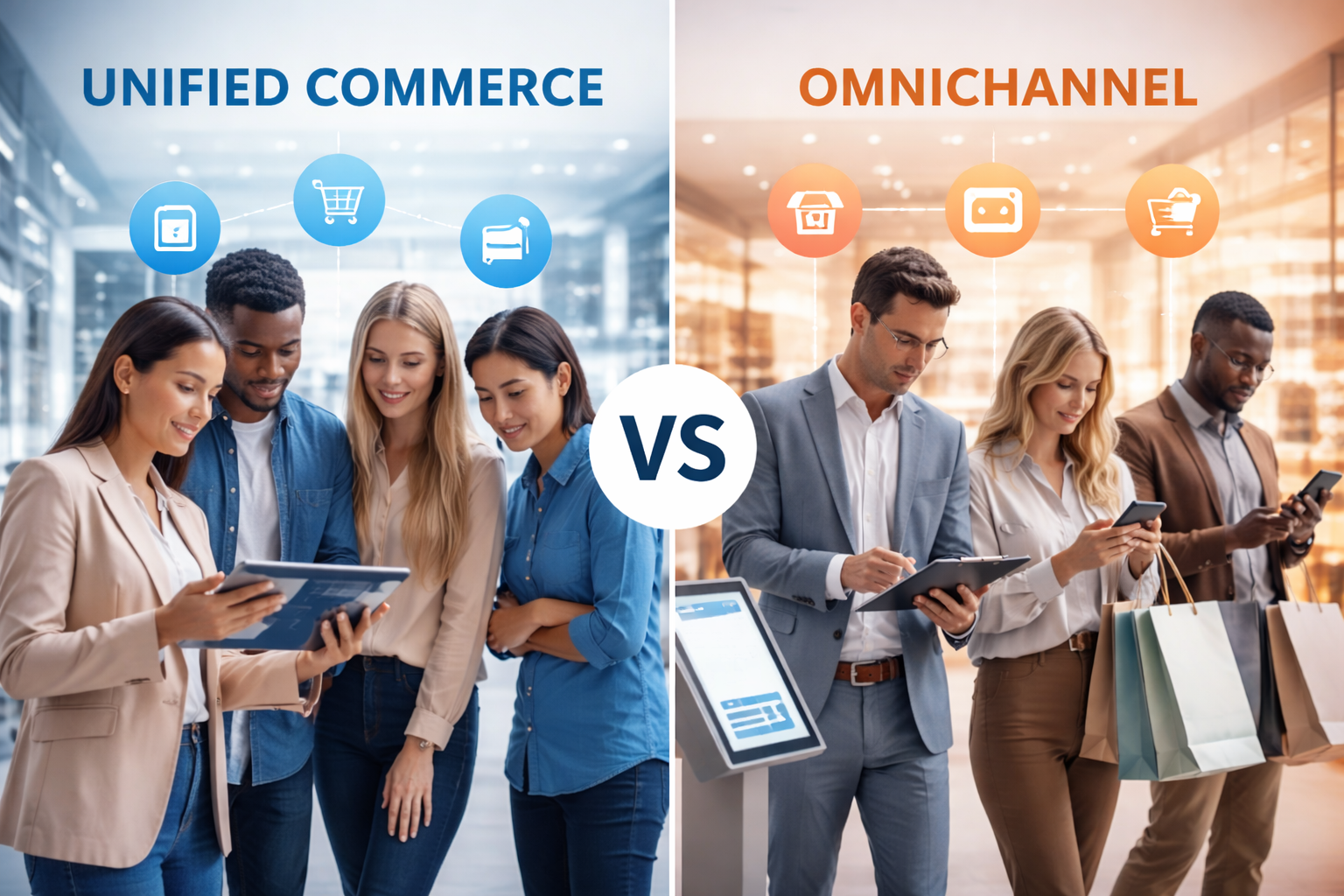
Unified Commerce vs Omnichannel: What’s the Difference?
Understanding the evolution of customer experience, data unification, and commerce architecture.
Introduction
Retailers, telecom operators, and subscription businesses often use the terms omnichannel and unified commerce interchangeably. But in 2026, the two models deliver completely different outcomes.
One focuses on connecting channels.
The other focuses on connecting data, transactions, payments, loyalty, subscriptions, and customer identity into one unified platform.
This guide explains the difference between unified commerce vs omnichannel, why unified commerce is now the preferred architecture for digital transformation, and what modern enterprises should adopt to stay competitive.
1. What Is Omnichannel Commerce?
Omnichannel commerce integrates multiple customer touchpoints—stores, ecommerce, mobile apps, social commerce, chat, and call centers—so customers have a consistent brand experience.
Key goals of omnichannel:
Create consistency across channels
Allow customers to shop anywhere
Enable channel switching (store → online → mobile)
Offer standard loyalty and promotions across locations
But while channels are connected, the systems behind them often are not.
Most omnichannel implementations still operate with:
Separate POS systems
Separate ecommerce platforms
Separate loyalty databases
Fragmented customer profiles
Multiple billing or payment systems
Batch-based data synchronization
This creates operational gaps, delays, and inconsistent experiences.
2. What Is Unified Commerce?
Unified commerce goes beyond connecting channels.
It unifies data, payments, transactions, pricing, inventory, loyalty, subscriptions, and customer identity into a single platform.
Instead of multiple systems feeding each other through APIs, unified commerce creates a real-time source of truth for:
Customer 360
Unified pricing
Wallet & payments
Loyalty & rewards
Subscriptions & billing
Orders & transactions
Promotions & offers
Unified commerce enables:
One customer profile across all channels
Real-time earn/burn of loyalty everywhere
Unified digital wallets for all payments
Consistent inventory and pricing
Instant refunds and credits
Seamless subscription management
Retail + digital service bundling
Faster launches of promotions and new revenue models
This is why unified commerce is now considered the natural evolution of omnichannel.
3. Unified Commerce vs Omnichannel: The Key Differences
| Feature | Omnichannel Commerce | Unified Commerce |
|---|---|---|
| Focus | Consistent experience | Real-time data unification |
| Architecture | Multiple systems connected | One unified platform |
| Customer Data | Fragmented profiles | Real-time Customer 360 |
| Payments | Different processors | Unified wallet + payments |
| Loyalty & Promotions | Limited, not real-time | Unified rewards + real-time logic |
| Subscriptions | Often separate systems | Native subscription billing |
| Personalization | Basic | Intelligent and predictive |
| Refunds & Credits | Slow/manual | Instant via wallet |
| Revenue Models | Traditional retail | Retail + subscription + services |
| Time-to-Market | Slow | Fast and scalable |
In short: omnichannel is about experience, unified commerce is about architecture.
4. Why Omnichannel Falls Short in 2026
Customer expectations in 2026 require:
Real-time personalization
Cross-channel loyalty
Instant refunds
Seamless identity and payments
Unified inventory and fulfillment
Subscription-based offerings
Wallet-powered customer journeys
Legacy omnichannel systems cannot support these requirements without heavy customization and high integration costs.
Common limitations include:
Batch synchronization delays
Loyalty not posting instantly
Pricing inconsistencies
Separate billing engines
POS systems unable to redeem digital offers
Fragmented subscription management
Businesses need a single, real-time commerce engine to deliver modern experiences.
5. Benefits of Unified Commerce
Switching to a unified commerce model delivers measurable gains:
Higher customer lifetime value
Real-time engagement + personalized offers + unified loyalty.
Increased conversion rates
Consistent pricing + seamless payments + fast checkout flows.
Lower operating costs
Fewer systems → fewer integrations → fewer errors.
Faster innovation
New promotions, bundles, or subscription models launch in days, not months.
More accurate data
One real-time view of customer activity, payments, and transactions.
Improved loyalty and retention
Wallets, rewards, and offers instantly integrated across every touchpoint.
New revenue streams
Brands can introduce subscriptions, digital services, bundles, and partnerships.
6. Use Cases Where Unified Commerce Outperforms Omnichannel
Retail & Quick Service Restaurants
Real-time loyalty earn/burn at POS
Mobile ordering + wallet payments
Subscription meal plans
Personalized offers at checkout
Telecom & Media
Unified billing across mobile, data, subscriptions, and live TV packages
Cross-service bundles
Wallet-powered microtransactions
Energy & Utilities
Usage-based billing
Digital wallets for top-ups
Instant refunds and credits
Subscription EV charging plans
Hospitality
Prepaid wallet experiences
Unified loyalty across dining, hotel, and delivery
Personalized booking incentives
7. How to Transition from Omnichannel to Unified Commerce
Enterprises typically follow this roadmap:
Step 1 — Centralize customer identity
Merge fragmented profiles into Customer 360.
Step 2 — Adopt a unified payment & wallet hub
Enable real-time earn/burn, refunds, and payments.
Step 3 — Connect POS, ecommerce, and mobile through one platform
Reduce complexity and remove duplicate logic.
Step 4 — Integrate subscription billing
Enable recurring revenue and flexible product bundles.
Step 5 — Unify promotions and loyalty
Run offers in real time across every channel.
Step 6 — Leverage analytics for personalization
Use a single source of truth to drive engagement.
8. Which Approach Should Your Business Choose?
If your goal is simply to make channels look consistent, omnichannel may be enough.
But if your goals include:
Faster time-to-market
Lower operational cost
Real-time customer engagement
Subscription revenue
Seamless payment experiences
Loyalty automation
Unified reporting
Then unified commerce is the clear winner.
Modern brands cannot scale on fragmented systems.
Unified commerce provides the agility required for 2026 and beyond.
9. Final Thoughts
Omnichannel was a crucial step in commerce evolution, but it is no longer sufficient.
Today’s customers expect real-time, personalized, frictionless experiences powered by unified data and a single transaction engine.
A unified commerce platform delivers:
Better experiences
Faster performance
Higher revenue
Stronger loyalty
More accurate operations
This is why leading retailers, telcos, media providers, QSR chains, and energy companies are moving from omnichannel to unified commerce.

B2B SaaS Sales & Product Marketing nerd by day, growth whisperer by night.
Here for the retention, not the churn.


